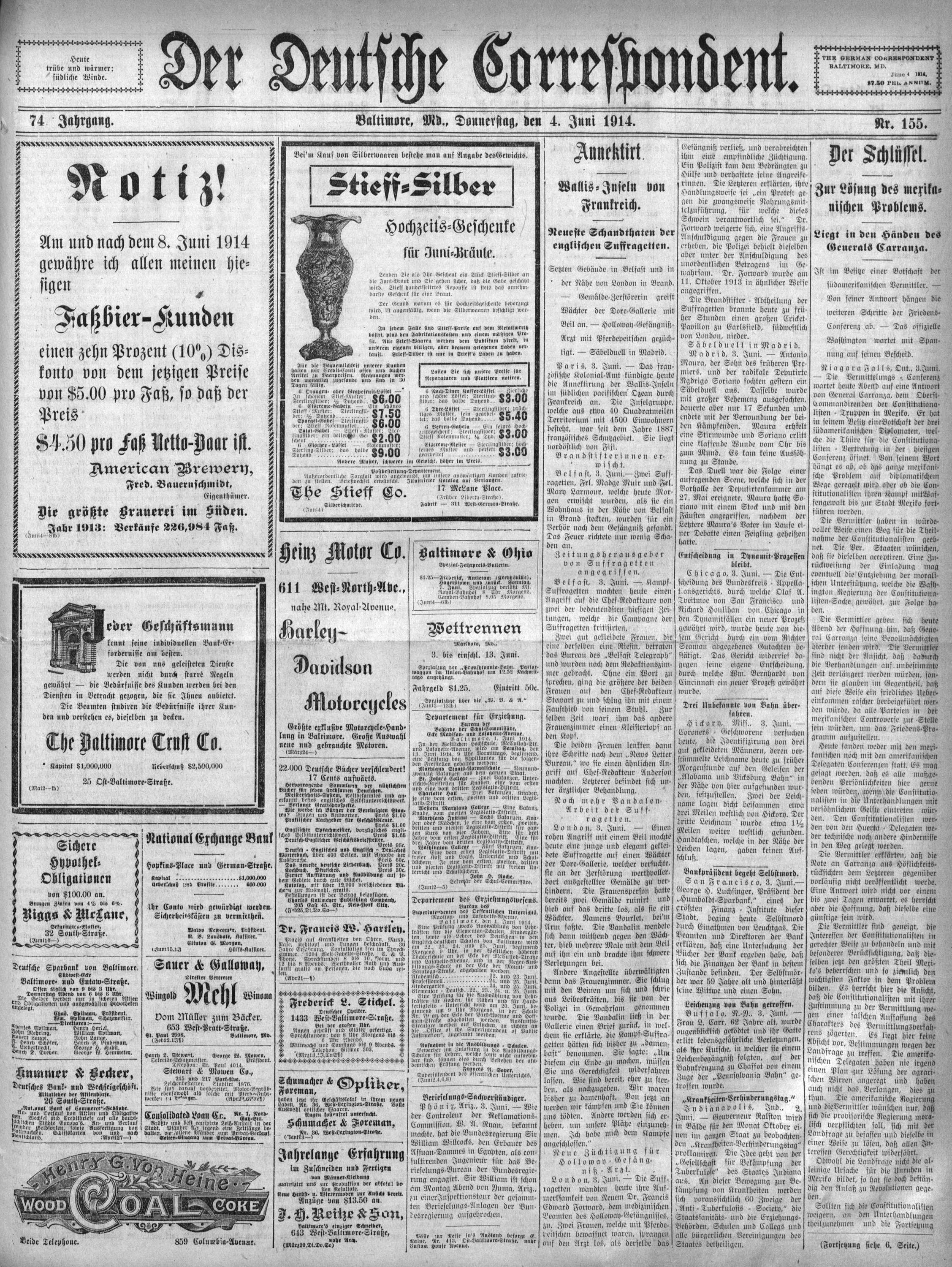
The following text is a translation of the cover of page Der Deutsche Correspondent on June 20, 1914. The translation is by K. Barbour of Edward Larkey’s German language class, University of Maryland Baltimore County, Spring 2011.

June 20, 1914
Accident in Quarry – Explosion in Hillcrest Mine
Probably Over Two Hundred Lost
Only fourteen out of the fifty that were salvaged in the wreck were alive altogether two hundred and fifty minters were buries under the rubble and earth. Toxic gas hampers rescue teams, Mining catastrophe in Belgium turns out well.
Lethbridge, Alberta, June 19th — As a result of an intense explosion in Mine no. 20 of the Hilcrest Collieries, Ltd., two hundred and fifty miners were buried today in the Crows Nest district, near Fernie, B.C. Of the fifty workers who were pulled from the wreckage, only fourteen were found to be alive. The rescue team has been organized by a number of knowledgeable miners in the area, though their prospects are pretty bleak of finding the over two hundred men to pull out, due to the poisonous gas and extensive debris,.
Some six hundred men entered the mine this morning before the explosion, and three hundred and fifty of them were brought to safety. Shortly thereafter, officials of the Canadian Pacific Railway Company sent a train with several nurses, and medicines of all kinds to the site of the wreck in hopes of helping in any way possible. A rescue team from Blairmore sent by the federal government then joined them.
As the day wore on and dusk approached, a number of women stood anxiously near the mine, waiting and hoping that their loved ones would be found. Their cries for help which had reached the surface earlier, went silent. , The women finally left to go home, with tear stained cheeks. The explosion occurred around 9:00 am and carried such a strong force that it took off the roofs of many of the miners’ small houses nearby and demolished large buildings in the neighborhood.
– – –
AMAZING ESCAPE AS DEATH LOOMS INCHES AWAY
Liege, Belgium, June 19th– A fire ripped through the Vieille Marihaye mine yesterday, burying two hundred coal miners until this morning. Some two hundred of their fellow work mates were able to get out safely when they heard the alarm. The fire still raged on into the afternoon and a rescue team did everything in its power to free the helpless miners.
(Later.)
After hours and hours of selfless and heroic work, the brave rescue workers finally brought all of the miners to the surface.
– – –
AN UNTIMELY DEATH…
London, England, June 19th– Sir John Edward Gray Hill, the nephew of the reformder of the Postal Service was found in dead in his bed this morning. He complained of feeling ill the evening before, but his death was completely unexpected. Sir John, who was 75 years old, was an important figure in the area of marine law, and was president of “The Law Society” from 1903 to 1904.
– – –
SERBIA WARNS TURKEY
Constantinople, June 19th– Serbia has warned the Turkish sultancy that it will not be able to maintain an amicable relationship with the country should Turkey initiate war with Greece. It is believed that this warning has dampened the spirits of Turkey’s warmongers who are currently trying to induce the government to begin hostilities.
– – –
AIRPLANE CRASHES
-Two dead, two severely injured. – Two military pilots perish in Petersburg.
-Twelve people killed in tragic landslide in train tunnel. -Anxiously awaiting consequences of Beiliss Case.- Vera Tcheberiak’s brother arrested.- Allegedly involved in Murder of Yuihinksy boy.
St. Petersburg, June 19th- The Russian military pilot Sopokine was killed today in the Gatchina Aerodome when he tragically plummeted to the ground from a considerable altitude. A second military pilot by the name of Janowski, was killed in an accident later on that day in the Aerodrome.
– – –
PILOT AND PASSENGER SEVERELY INJURED
Stolkholm, June 19th- Lieutenant G. De Porat, a military pilot, and M. Hygerth, his passenger, suffered serious injuries today when his airplane fell one hundred feet to the ground. The plane crashed near Jonkoping and was the first serious airplane crash in Sweden.
– – –
TWELVE DEAD IN LANDSLIDE
Nice, Italy, June 19th- A landslide in a tunnel crashed onto the railway today, killing twelve people on the train from Nice to Cuneo, Italy and severely injuring seven others. It is feared that many more people lie helplessly buried under all the debris.
– – –
VERA LCHEBERIAK’S BROTHER ARRESTED
Kiev, Russia, June 19th- Singaievsky, brother of Vera Tcheberiak, known for his role in the court case regarding the murder of young boy, Andreas Yuihinsky against the accused suspect Mendel Beiliss, was arrested by authorities today. At the same time, Vera is being kept under close surveillance by the police. The woman has been expelled from the organization, “Black Hundreds” had been, which is a sure indication that the expected legal action would be brought against the her.
Two detectives testified at the Beiliss hearing, explaining how they had posed as criminals after hearing from Singaievsky. They had heard that he, along with Rudzinsky and Latisheff at Vera Tcheberiak’s house- the supposed crime scene where thieves and other riff-raff gathered, had killed Yuihinsky.
Vera Tscheberiak had recently had a libel suit brought against Yablonovsky- the editor of “Kievsky Misl”, the same day that he identified her as the accomplice of the murder in his newspaper. Mr. Yablonovsky was able to provide sufficient evidence however, that allowed for his aquittal.
– – –
Guilty of Defamation
St. Petersburg, June 19th- The case against the twenty five lawyers associated with the Beiliss lawsuit has finally ended. All defendants have been found guilty, each serving six months in jail, except for two, who will serve eight months. At the time of the Beiliss trial, the lawyers had declared that the Ministry of Justice and the court in Kiev was was biased by racial and national prejudice.
– – –
SUFFRAGETTES SET CHURCH ON FIRE
London, June 19th- The Arson-Division of the militant Suffragettes attempted arson last night to burn down a church in Beckenham, a southeastern city in the suburbs of London. The flames were quickly extinguished and the damage was only minimal.
– – –
(Fourth Column)
STILL HOPE FOR A SUCCESSFUL PEACE CONFERENCE. ONE NEGOTIATOR`S POINT OF VIEW.
-The same viewpoint shared by State Secretary Bryan. -Throughout the day, Argentinean Ambassador Naón held long conferences with the President and the Secretary Bryan. – Events inside Mexico.
WASHINGTON, JUNE 19TH.-Before Argentinean Ambassador Naón traveled from here to Niagara Falls, he spoke at length into the late hours of the night with President Wilson and State Secretary Bryan today in Washington D.C. He declared that he still had hopes that the Peace Conference goals would be achieved. Naón is one of the three negotiators from South America. After the discussion with Ambassador Naón, State Secretary Bryan also stated that he doesn´t yet have doubts about the success of the negotiators to carry out their plans.
–EITHER, OR-
NIAGRA FALLS, JUNE 19TH- Judge Lamar’s memorandum to Señor Emilio Rabasa, leader of the Mexican delegation,was an ultimatum that declared that the United States would insist on the acceptance of its plans for Mexico’s pacification. If the Huerta Delegation does not comply, then the mediation conference will come to a conclusion tomorrow or Monday. The United States have made their position unmistakably clear to the negotiators. Brazilian ambassador da Gama and Chilean ambassador Suarez approached the Americans and were curious to know if the Americans’ opinion had changed due to the tense relationship between Carranza and Villa, though they received a negative response.
The negotiators held no formal meeting today because Argentinean ambassador Naón stayed in Washington for the day but is expected back tomorrow. General Huerta reported from Mexico City that Señor Pedro Lascurain was appointed Foreign Minister, which could potentially change the entire situation if Señor Lascurain completely disregards the negotiations made by the mediators and is appointed provisional President.
Señor Lascurain had the foreign minister’s portfolio under Madero’s rule and became the provisional president since (now former) President Francisco Madero has been overthrown. He then appointed General Huerta to his cabinet and shortly thereafter relinquished his position of President to the general. In Constitutionalist circles, Señor Lascarain would hardly be acceptable as President, because he was accused of being too accommodating to General Huerta
LAREDO, TEXAS, JUNE 19TH- Fifteen generals in the Constitutionalist army, composed of some thirty thousand men, sent a letter to headquarters at the time of Villa’s resignation and renounced their allegiance to General Carranza. Villa did not sign the note. This information was previously held back due to strict censorship in Saltillo but arrived here today, along with many travelers from Saltillo and Monterrey. According to informed sources, the note claims that the top leaders are aware that the generals will continue their fight against General Huerta, but will only obey the orders of General (Pancho) Villa and will no longer recognize General Carranza. When the travelers left Saltillo, the situation at hand at yet to be fixed by the compromise published later on.
(Continued in column 5) Recent plans indicate that General Pablo Gonzales would attack San Luis Potosi, while Villa would try to capture the city of Zacatecas and then move south to Mexico City as originally planned. Simultaneously General Obregon would march from the west to the capital city.
– – –
(Fifth column)
POLICE INSPECTOR SHOT DEAD.
-While attempting to apprehend a murder suspect.
– Suspect severely wounded.
BOSTON, MASSACHUSETTS, JUNE 19TH- Police Inspector Thomas F. Norton was killed in an attempt to arrest Lawrence Robinson, who is wanted for allegedly three murders in Grand Rapids, Michigan. Robinson was severely injured as Mr. Norton tried to apprehend the Robinson Two other police inspectors and a friend of Robinson’s, Joseph Daniels, took part in the firefight, which began in a restaurant (in the business section) and continued into the street outside. Nearly fifty rounds were shot and luckily, Daniels was apprehended.
ARE MURDER AND ROBBERY INVOLVED?
GRAND RAPIDS, MIGHIGAN, JUNE 19TH- Lawrence P. (“Chippy”) Robinson is wanted for his involvement with the robbery at Thompson’s Jewelry Store, where three store employees were shot by two thieves. The robbers ran off with twenty-two hundred dollars worth of diamonds. A reward of two thousand dollars has been posted for anyone who captures Robinson.
THINGS NOT LOOKING GOOD FOR TEPIC, MEXICO
ABOARD THE BATTLESHIP, “CALIFORNIA” IN MAZATLAN, MEXICO, JUNE 19TH (by wireless transmission to San Diego, CA)- Refugees arrived last night and this afternoon on the steamship, “City of Para” (from “Pacific Mail Line”) from the besieged city of Tepic. They reported that conditions in the city are desperate. The censorship is so strict that no more details are available, Forty American refugees have already left on the “Para” for San Francisco today. The long siege and the scarcity of food have driven even those foreigners out of the country who until now have stayed behind for health reasons.
GENERAL CABALLERO’S SUCCESSOR.
TAMPICO, MEXICO, JUNE 18TH (via Laredo, June 19th)- Colonel Lopez Delara will replace General Caballero as Military Governor in Tampico. General Caballero left for Monterrey today, as he will be deployed once again for active duty.
SOLDIER COMMITS SUICIDE.
SPOKANE, WA, JUNE 19TH- Julius Denow, a 45-year old employee of the “C” Company, 14th Infantry Regiments sadly shot himself today, using his own gun immediately following his arrest, as he abandoned his post without taking approved leave). Mr. Denow already had seven years of service under his belt and only needed two more years before he could have retired.
BANKRUPTCY PROCEEDINGS.
CHICAGO, JUNE 19TH- Last week, the State Bank Examiner closed down The La Salle Street Trust and Savings Bank and today opened bankruptcy proceedings. Dr. W.C. Riblack, Vice President of the Chicago Title and Trust Company, was officially appointed liquidator for the bank, and must put up a $2,500,000 bond.
YALE WINS.
NEW LONDON, CONNECTICUT, JUNE 19TH- Yale won this afternoon’s boat race against Harvard on the Thames River, by only four inches and proving to be one of the most exciting races ever held. Both boats forced their way through the water, neck to neck at one point, so that the outcome could not be determined for some time. At first, Harvard was declared the winner.
ROUNDTRIP TO PHILADELPHIA ONLY $2.00
Pennsylvania Railway, next Sunday- special train Union Station at 8:20 am
- $1.50 roundtrip to Wilmington.
- $1.75 roundtrip to Chester.
Tickets sold Saturday and Sunday.





 MdHS Hilgenberg Archive's Blog


